
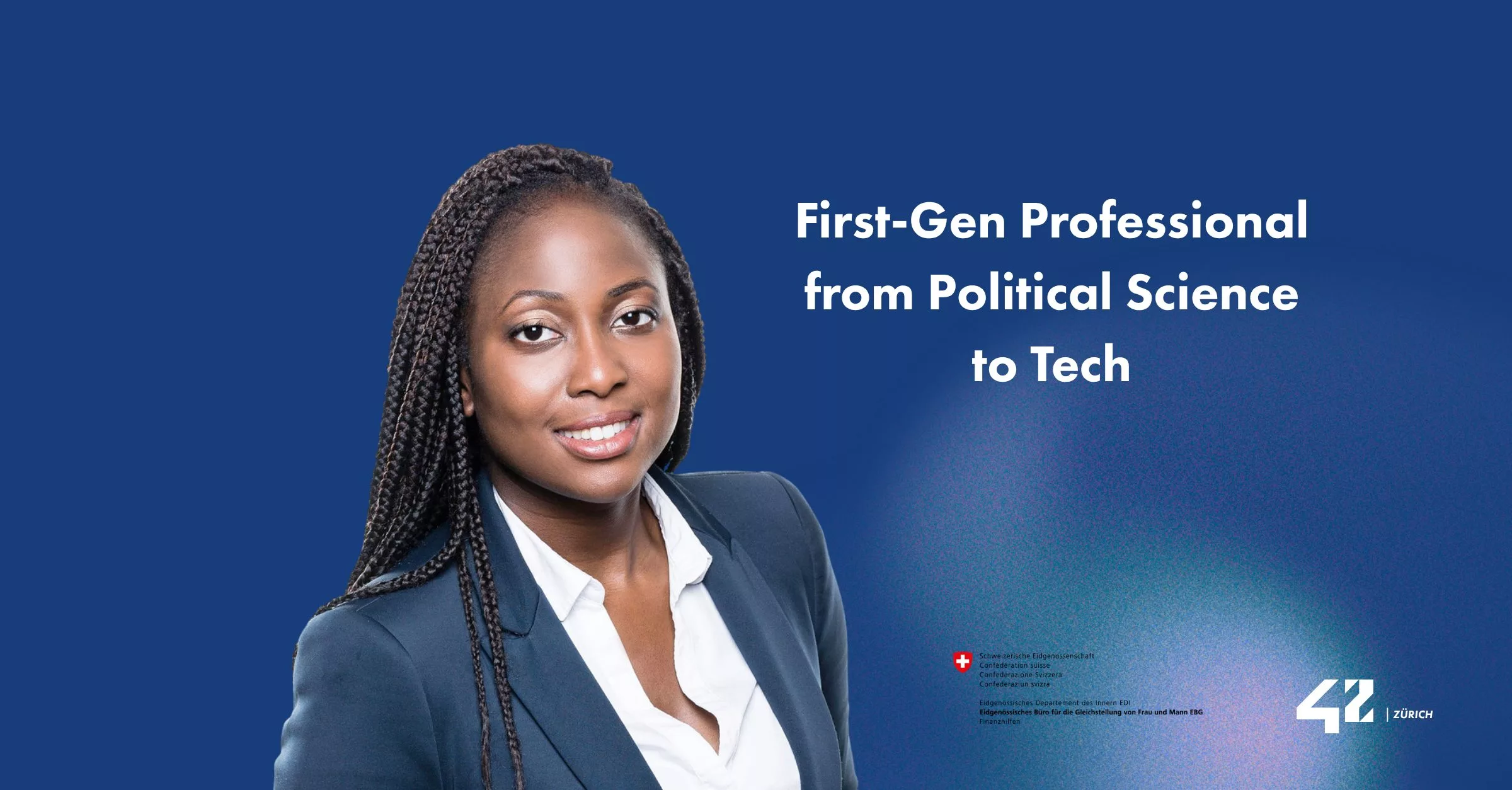
Many first-generation professionals – the first in their family to pursue an academic or professional career – are familiar with the feeling that their path isn’t ‘good enough’. Claudia Bruce-Quartey’s story proves that it is precisely these supposed disadvantages that can become strengths in the tech world.
Her career path does not read like a typical tech CV: she studied political science, followed by roles in business development and sales at Cisco, Salesforce and Red Hat. No formal training in computer science, no traditional tech work placements. Yet it is precisely this unusual combination that has made her a sought-after expert.
“I didn’t have any mentors or role models – just the determination to make my mark. Tech isn’t just for computer scientists. It requires strategy, communication and passion – and anyone can bring those qualities to the table.”
From political science to the tech sector: Why detours are a strength
Claudia’s journey began with a dream: she wanted to work for international organisations such as the United Nations or the European Union to help Ghana and the African community move forward. However, after completing her Master’s degree in France, she soon realised that the reality was quite different. The jobs were often short-term, poorly paid or didn’t match her aspirations. “I had a Master’s degree and yet I still struggled to find a long-term job where I could fulfil my potential.”
The turning point came in 2015, when she landed an entry-level role in sales – a far cry from her original vision. “This can’t be it. There must be a better way,” she thought. But instead of giving up, she opened herself up to new possibilities. A Cisco programme for young sales talent piqued her interest: “Suddenly I realised that tech isn’t just about coding. It’s about solutions that help businesses move forward – and that’s exactly where my skills come in.”
“Tech is more than just code. It’s about problem-solving, understanding customers and innovation. If you’ve got these skills, you’re already well on your way.”
First-generation challenges: without a network or role models
As a first-generation professional, Claudia had no established network in the tech industry. “There was no one in my family or among my friends and acquaintances who worked in IT or sales. I had to figure it all out on my own.” But rather than letting that discourage her, she drew on her adaptability and her willingness to learn.
In the tech world, she soon realised that it wasn’t just about technical knowledge. “At first, I thought that if I just learnt enough, everything would become easier. But then I realised: it’s also about who I am – a woman, a Black mother in a male-dominated industry.” She learnt to assert herself, stand up for herself and make her achievements visible – something that many first-generation professionals only learn later on.
Motherhood as a driving force
As a young mother in Switzerland, Claudia faced yet another challenge: how could she balance her career and family in an industry that is often still not very family-friendly? “The first six months were tough. I wondered whether the decision to move to Switzerland had been the right one.” But she didn’t give up. Instead, she used her experiences to empower other women – as co-founder of the Iconic Women Circle and as a #IamRemarkable facilitator for Google.
“Motherhood isn’t a break in your career. It teaches us how to multitask, be resilient and set priorities. That’s exactly what the tech industry needs.”
First-gen professional? Your unique story is exactly what the tech industry needs!
Claudia Bruce-Quartey’s story shows why first-generation professionals are not only welcome but indispensable in the tech world. They bring exactly what the industry needs: fresh perspectives, because they have different experiences; adaptability, because they have learnt to find their feet in new environments; and problem-solving skills, because they know how to make the most of limited resources. Her strategic thinking, honed during her political science studies, her negotiation skills from her time in sales, and her multilingualism (German, English, French, Twi, Ga) were precisely the skills that made her irreplaceable in the tech world.
But Claudia has also learnt that self-promotion is crucial – especially for first-generation professionals and under-represented groups. “Many women work hard, assuming that someone will eventually recognise their achievements. But the reality is: if you don’t make yourself visible, you’ll be overlooked.” Her advice is clear: write down your achievements – set aside 20 minutes every week to jot down 10 things you’ve done well. Talk about your achievements – arrange regular meetings with your line manager and highlight what you’ve achieved. And above all: build a network. “Your professional network is your currency for new opportunities.”
“Courage is so important because we often have to act without self-confidence. If you have the courage to take the plunge, you can achieve more than you think.”
Your ‘chaotic’ path is your superpower
Claudia’s story is proof that first-generation professionals, with their unconventional career paths, bring exactly what the tech world needs. Whether as a mother, a career changer or a career strategist: her so-called ‘detours’ have made her the person she is today. “I’ve learnt that I have intrinsic value – and that value is growth. No matter what industry I’m in, I find ways to develop myself further.”
If you think your path is ‘too unconventional’ for the tech industry, think again. Perhaps it’s precisely these detours that are your greatest asset.
About Claudia Bruce-Quartey
Claudia is a political scientist, a mother of two, a key account manager at Red Hat and a career strategist for first-generation professionals in tech, as well as a children’s book author, speaker and mentor.

This article is part of the initiative to promote gender equality in computer science education, which is supported by the Federal Office for Gender Equality (EBG).