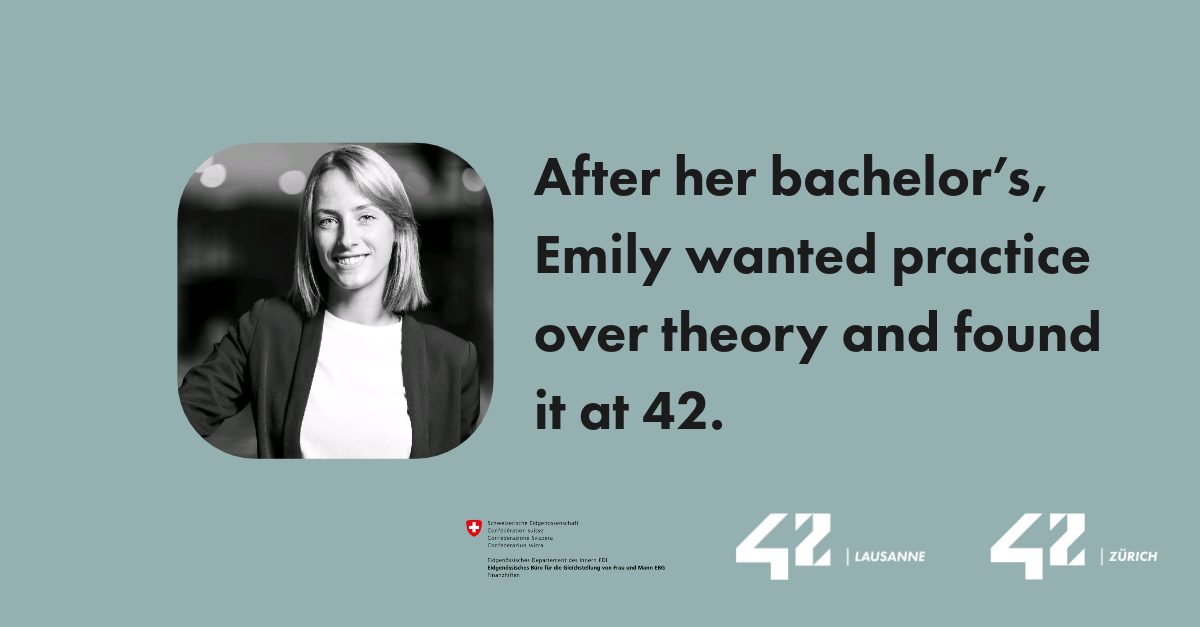
After completing her bachelor’s degree in Business Informatics, Emily Sali was faced with a decision that many people don’t have to make: whether a master’s degree was really the right next step. Her answer led her to School 42.
Choosing a degree course with a sense of logic
Emily had been fascinated by maths and logical thinking from an early age, so it’s no wonder she chose to study in this field. When faced with the choice between Computer Science and Business Informatics, she deliberately opted for the latter, partly because of the higher proportion of women on the course. Emily looks back fondly on her time at university, including an anecdote she still recounts with a smile: in some exams, code actually had to be written by hand with pen and paper, without any compiler to tell you straight away whether it worked at all. For the budding programmer in her, this was an amusing prospect and a small foretaste of the fact that her day-to-day studies were still lacking a bit of practical experience.
“A lot of it remained theoretical. I wanted to be able to try things out and build things myself.”
– Emily Sali, 42, alumna
The question of the Master’s degree
It was precisely this desire to try things out and build things herself, rather than just reading about them, that drove Emily when it came to taking the next step after her bachelor’s degree. For most people, the choice was clear: a traditional master’s degree. Emily, too, embarked on this path in early 2021, in the midst of the pandemic. But early on in her Master’s programme, the same pattern as before emerged, only more pronounced: even more theory, even more academic work, whilst what she actually wanted – namely, to build real things – continued to take a back seat.
“Spending even more time on academic work and a thesis just didn’t feel like the right path for my future.”
Instead of simply seeing the path she had chosen through to the end, Emily made a conscious decision against it and in favour of 42.
The Piscine as an open trial
When Emily joined the ‘Piscine’ – 42’s intensive induction phase – she wasn’t yet sure whether this path would really be the right one for her. That was, after all, the whole point of this trial phase: to find out whether you’d be comfortable with this learning format before committing to it in the long term. Even with prior programming experience, getting to grips with the C language was by no means a given. Unlike at university, the focus here wasn’t on recalling knowledge for an exam, but on working out solutions for oneself through trial and error – trying things out, failing, and trying again.
Whilst on the Common Core, 42’s core programme, Emily was already working full-time. That is why she has particularly fond memories of completing Transcendence, the Common Core’s final major project: With just the four of us, coordinated entirely remotely and completed under time pressure, the challenge was all the greater because the other team members were also already working full-time at that point. Juggling everything – job, project and team – was a logistical feat in itself.
“It took a great deal of time to organise the Common Core final project remotely with my team and complete it on time, especially as we were all already working full-time at the time.”
What was missing from a traditional degree course
If you ask Emily what she learnt at 42 that a traditional degree course probably wouldn’t have taught her, she quickly mentions things that are rarely found in a curriculum: working in a team, explaining code in a way that even someone with no prior knowledge can understand, and learning to simply carry on despite setbacks, rather than letting them hold you back. She describes 42’s peer-to-peer approach – which does away with traditional teachers altogether – as one of the most formative aspects of her time there: the feeling of being in the same boat as everyone else.
How a part-time job became a career path
It wasn’t clear at the start of her time at 42 that Emily would eventually specialise in mobile development, and iOS in particular. The deciding factor was a student job with a provider of further training in app development, through which she first really came into contact with iOS. Her ability to break down complex concepts into understandable terms – a direct by-product of peer-to-peer learning at 42 – quickly opened doors for her there.
Even when making the leap from 42 into the world of work, it became clear that the school’s name carries weight: in job interviews, 42 repeatedly sparked genuine interest, precisely because many employers were not yet familiar with the school and asked about it out of curiosity. From that time, there are two habits in particular that have stayed with Emily in her work to this day: thorough code reviews and testing code before it’s too late.
Explaining as part of the work
Alongside her own development work, Emily has continued to prioritise sharing technical knowledge. In her own words, explaining complex concepts to others has made her a better programmer herself; anyone who wants to make something understandable quickly realises where their own gaps in knowledge lie. For her, there is also a wider cause behind this: in a field that remains male-dominated, female and encouraging voices are rare. This is precisely where Emily wants to make a difference.
“I approach difficult challenges differently these days. Everyone has their own way of learning even complex subjects, and nobody can explain that to you – it’s all about learning by doing.”
A realisation that has stayed with me
When asked what she really understood for the first time at 42, Emily doesn’t have to think twice: that a job in IT can also be a career involving plenty of social interaction – the antithesis of the cliché of the lonely programmer sitting in front of a screen.
According to Emily, anyone considering taking a different path to the traditional one doesn’t need to have all the answers just yet.
All you need is to be curious enough to give it a go.
– Emily Sali, 42, alumna
About Emily Sali
Emily Sali is an iOS developer and a graduate of 42 Lisboa. After completing her bachelor’s degree in Business Informatics, she made a conscious decision not to pursue a traditional master’s degree and instead chose 42. Following her graduation, she gained several years’ experience as an iOS developer in Zurich and Berlin. Today, she works on her own app projects, combining her knowledge of mobile development with a passion for explaining and teaching.