
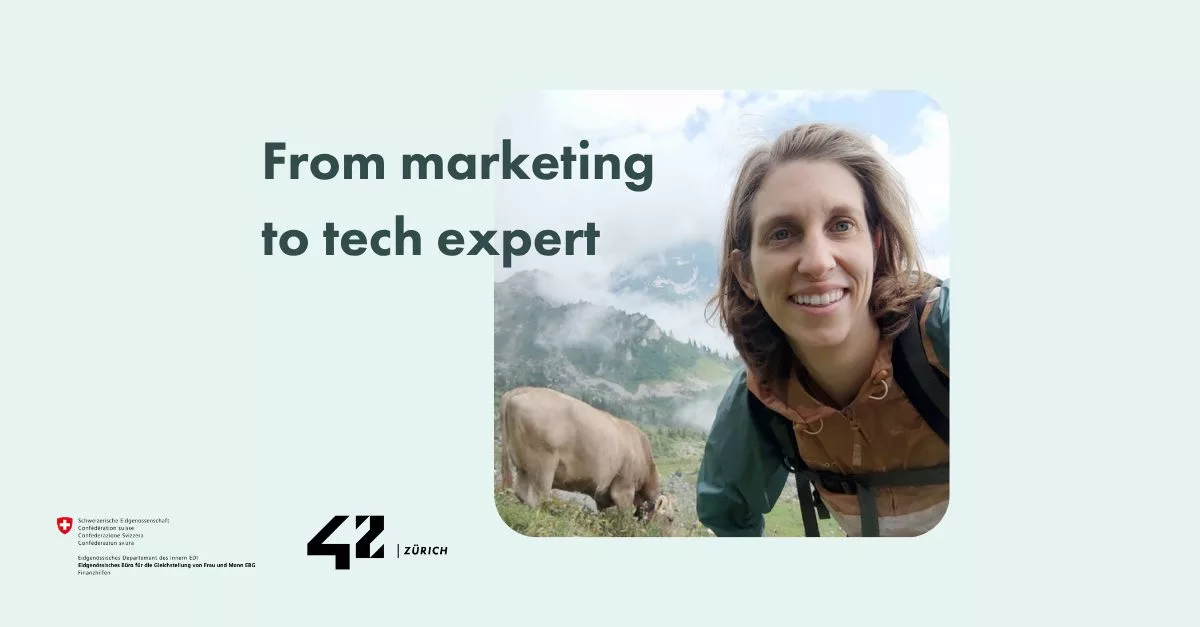
Corina Burri studied business administration, specialising in marketing, and embarked on a traditional career in communications. Today, she is an SEO/GEO expert, a self-employed entrepreneur and an advocate for greater female representation in the tech industry. “Nobody looked at my university degrees,” she says quite bluntly as we discuss her career path. “I got my first job before I’d even got my bachelor’s degree.”
Her story is a plea against the fear of ‘not being good enough’ and proof that, in the tech world, drive is often more important than a degree.
From marketing to Swiss tech expert
For Corina Burri, the path into the tech world was a gradual “growing into” the field. After completing her commercial apprenticeship and earning a bachelor’s degree in business administration, she worked in marketing for many years. In doing so, she inevitably came into contact with digital transformation: she led website relaunches, implemented ERP interfaces and developed content strategies from the initial idea through to implementation. “I’ve always been digitally savvy,” she recalls. “But above all, I’m not afraid to learn something new.”
Corina Burri moved to Barcelona to study for her Master’s in Brand Management. As local wages were enough to maintain her standard of living, she started working as a freelancer. She soon realised that SEO copy paid better than traditional copy. It quickly became clear that this job involved far more than just writing: it was all about technology. “I realised that SEO is very technical,” says Corina. “I had to understand how Google works, how to analyse data and how to optimise content.”
“You have to learn a great deal on your own, independently. Curiosity is absolutely vital.”
In her next role as Head of Marketing, she developed new content formats, conducted user interviews and utilised ‘programmatic SEO’ to scale landing pages. She developed backlink strategies and used A/B testing to determine whether video or text converted better. Later, as a team lead at Credit Suisse, she carried out technical audits to improve the site’s visibility and built dashboards to measure its success.
Today, she is an entrepreneur, speaker and expert in SEO and GEO (Generative Engine Optimisation). “I stumbled into the tech world and learnt most of it on the job,” she sums up. There was no university course offering exactly this combination of content and technology. “You have to learn a great deal yourself, independently. I think curiosity is absolutely vital.”
Do you need a university degree for a career in tech? A personal account
But the hurdle that many women – and Corina Burri herself – first have to overcome is the inner conviction that you need a degree to even be entitled to practise the profession. “I think what helped me was letting go of the idea that you have to study something before you can actually start working in the profession,” she says.
“I’ve given up on the idea that you have to study something in order to do a job.”
Looking back, it’s clear that qualifications hardly mattered. “The only time I needed my degree was for the corporate job,” she recalls. “And I was able to apply very little of what I learnt at university in my professional life.” What really helped her? Not the complex calculations from her business studies degree, but the practical skills from her commercial apprenticeship: Excel formulas, pivot tables and conditional formatting.
Personal branding on LinkedIn: visibility as a door-opener
So how did Corina land her projects? By having the courage to put herself out there. She advises others not to wait for the perfect opportunity, but simply to get started. “If you don’t have any professional experience yet, just take on a hobby project. And then share what you’ve learnt on a blog or on social media.”
She considers visibility on LinkedIn to be particularly important. “Get past imposter syndrome and start posting, even if someone might see it and you later think: ‘What does that person think of me?’” Her advice? “It might be just one person, but everyone else will think: ‘Ah, cool, good insights.’ Even if it’s just basic knowledge, there’s bound to be someone who finds it helpful.”
“Start posting on LinkedIn, even if you’re worried about what others might think.”
“Vibe-Coding”: Developing websites using AI tools without any programming knowledge
These days, Corina Burri doesn’t just work with content; she builds tools herself. She talks about “vibe-coding” – an approach where she brings her ideas to life with the help of AI, without needing to master every detail of the programming language. One highlight was her presentation at the Google Search Central Live event: a small tool she built using AI to monitor whether important pages are being dropped from the Google index. “I went back and forth with AI and then built a little tool,” she explains. “It’s a bit scary, to be honest. When I write a Python script, I don’t understand every line. So I just give it a go and hope it works.”
But that is precisely the norm in the tech industry: “You’re always learning something new, even though you never feel like you’ve quite got the hang of it.”
The future: the ‘Agentic Web’
Corina looks far beyond traditional ‘search engine optimisation’ and describes a fundamental shift in the internet: the ‘Agentic Web’. Whilst we humans visit websites to read information or carry out actions, she believes that the web of the future will increasingly be used by AI agents.
“Even today, websites are no longer just used by people, but by AI agents,” explains Corina. “These virtual assistants actively visit the website, analyse the content and carry out specific actions. For example, they fill in contact forms, book appointments or purchase products without a human needing to be actively on the site.”
This has massive implications for web development. The code must be structured and formatted in such a way that AI agents can immediately recognise the page’s intent and carry out the desired actions. “You have to format the website – that is, the code – so well that the web agents can execute it,” says Corina. “It’s about giving the bot what it needs so that it can do its job.”
Corina is already using this technology in her work. “When I carry out an audit, an agent checks, for example, whether a specific page even appears on Google,” she explains. “I used to do this manually by searching on Google. Now the agent enters the command and gives me the result straight away.”
This shift also brings with it a new kind of ‘visibility’. It is no longer just about being found by people, but about being understandable and accessible to machines.
Changing careers to the tech industry: 3 tips
At the end of the conversation, one thing is clear. Corina Burri is an inspiration because she dared to learn. “I didn’t get my jobs because of my qualifications, but because I proved myself,” she says.
Her advice to all women who are hesitant: “Take the initiative, learn something for yourself and show that you’ve done so. Build your own visibility, too. For me, that opened the door to many projects.”
In a world that often focuses on titles, Corina’s message is clear: show what you can do. The rest will follow.
About Corina Burri
Corina Burri is a freelance SEO and GEO consultant who helps businesses maximise their visibility.
As a speaker, she shared her insights at international events and served as a judge at the Global Digital Excellence Awards.
As a co-organiser of SEOnerd-Switzerland, she organises events on the topic of SEO and supports speakers through coaching.

The interview was conducted by Corina Schedler as part of the initiative to promote gender equality in computer science education, which is supported by the Federal Office for Gender Equality (EBG).