
The curriculum
Our curriculum is project-based and practical. You’ll start with the basics and later specialise in areas such as AI, cybersecurity, web development or virtual reality. The curriculum incorporates the latest technologies, such as prompt engineering, large language models and modern system architectures. You’ll not only learn how to use AI tools, but also how to apply them responsibly and creatively.

Course structure
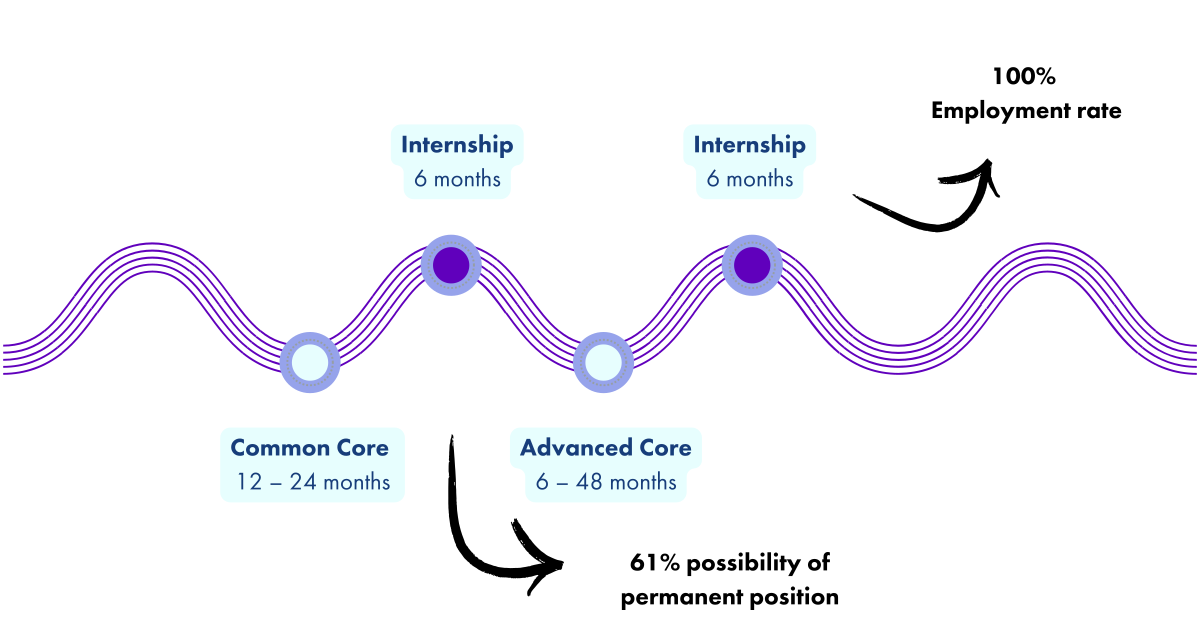
The Common Core is at the heart of our programme and equips you with the essential skills you need to enter the IT industry in 12 to 24 months. The curriculum consists of 7 thematic modules comprising over 27 projects.
The Common Core programme is followed by a six-month work placement to gain initial work experience.
After that, you’ll move on to the specialisation phase. Here, you’ll deepen your knowledge in the areas that really inspire you, gain professional experience and prepare specifically for your career.

Practice makes perfect
Flexible learning: You set your own pace and learn when and how it suits you.
No grades, just skills: you’ll get ahead by demonstrating your abilities in real-world projects.
Practical projects: Each module includes hands-on projects that will enhance your GitHub portfolio and prepare you for the job market.
Gamification: Progress through the levels just like in a game, and gain access to advanced specialisations from level 10 onwards
Common Core Modules
Fundamentals of Programming
Here, you’ll learn C programming from scratch: memory management, dynamic allocation, algorithms and more. You’ll build your own tools and libraries and develop a deep understanding of how computers work.
System administration
Learn how to set up, secure and manage server infrastructures. From virtualisation and networking fundamentals to container technologies such as Docker – here you’ll gain the skills needed to manage modern IT infrastructures.
Algorithms & Problem Solving
Develop an algorithmic mindset and learn to design efficient solutions to complex problems. From sorting algorithms to graph theory – here you’ll become a master of optimisation.
Object-oriented programming
With Python, you’ll learn the principles of object-oriented programming (OOP) and develop maintainable, elegant applications. From data manipulation to game development – this is where you’ll bring your projects to life.
Artificial intelligence
Discover the world of AI and large language models (LLMs). Learn how to build intelligent applications that understand, retrieve and generate information. From prompt engineering to autonomous agents – here, you’ll help shape the future of AI.
System and Network Programming
Develop high-performance applications that handle multiple tasks simultaneously and communicate seamlessly over networks. From multithreading to protocol development – here you’ll learn how modern systems scale.
Web development
Build complete web applications, including front-end, back-end and real-time communication. From API design to containerisation – here you’ll develop user-friendly and secure web solutions.
Job security
61% of our students find permanent employment following their Common Core placement – all after completing their specialisation and its associated placement.
100% practical
No theory without practice – you learn by working on real projects.
Future-proof
Our curriculum is constantly updated to prepare you for the demands of the tech industry.
Community
Learn in a collaborative environment where teamwork and mutual support are key.
Advanced Core Modules
Virus Programming
Learn how code can adapt and change itself – polymorphism, oligomorphism and metamorphism.
Security
Become a cybersecurity expert – identify vulnerabilities in systems and learn penetration testing.
Kernel & Low-Level
Build your own Linux-like system and program in assembly language.
Advanced Object-Oriented Programming
Deepen your knowledge of Java and C++ and master modern software architecture.
Functional Programming & OCaml
Discover functional programming with OCaml – for precise, mathematical code.
Graphical Branch
Create 2D/3D graphics using OpenGL and develop visually stunning worlds.
Virtual Reality & Unity
Create immersive VR experiences with Unity and shape the future of interactive media.
Mobile Development
Develop native mobile apps (iOS & Android) and work with modern APIs and SDKs.
Web development
Build scalable web apps using modern frameworks and real-time communication.
Algorithms
Deepen your understanding of complex algorithms and data structures.
Theoretical and Basic Mathematics
Learn linear algebra, Boolean algebra and signal processing – the foundations of AI and cryptography.
AI & Machine Learning
Develop intelligent systems – from gradient descent to neural networks.
DevOps & System Administration
Become an expert in Kubernetes, cloud servers and CI/CD pipelines.
Random Big Projects
Work in interdisciplinary teams on complex projects – from game engines to distributed systems.
Work Experience
Incorporate work placements, part-time jobs or start-up projects into your studies and gain valuable work experience.
International recognition and certificates
At 42 Zurich, your education focuses entirely on skills, experience and hands-on learning – not on grades or traditional diplomas. Once you have completed the core curriculum (Common Core), you can undertake a specialisation (Mastery) free of charge at any of the 42 schools worldwide – for example, in application, web or mobile development, databases or cyber security.
If you still wish to obtain a formally recognised qualification, there are currently two options:
Under certain conditions, 42 students can have their skills officially recognised by ICT-Berufsbildung Schweiz through the professional examination leading to the Federal Certificate as an ICT Application Development Specialist. This qualification is classified at Bachelor’s level.
Another option is to obtain an RNCP certificate. The RNCP (Répertoire National des Certifications Professionnelles) is a state-registered professional certificate that is aligned with the European Qualifications Framework (EQF) and is therefore recognised throughout Europe. RNCP certificates will only be available to students who complete specific projects and meet certain requirements.
Depending on the pathway you choose, you can either earn the title of IT Solutions Designer & Developer (EQF Level 6) at bachelor’s level or the title of IT Architecture Expert (EQF Level 7) at master’s level.
Ready for the challenge?
Whether you’re seeing code for the first time or are already experienced in programming – at 42 Zurich you’ll find the perfect introduction to the world of technology. Apply now and start your journey into the digital future!
P.S. Wondering about the cost? Thanks to our partners, the course is free for you!