
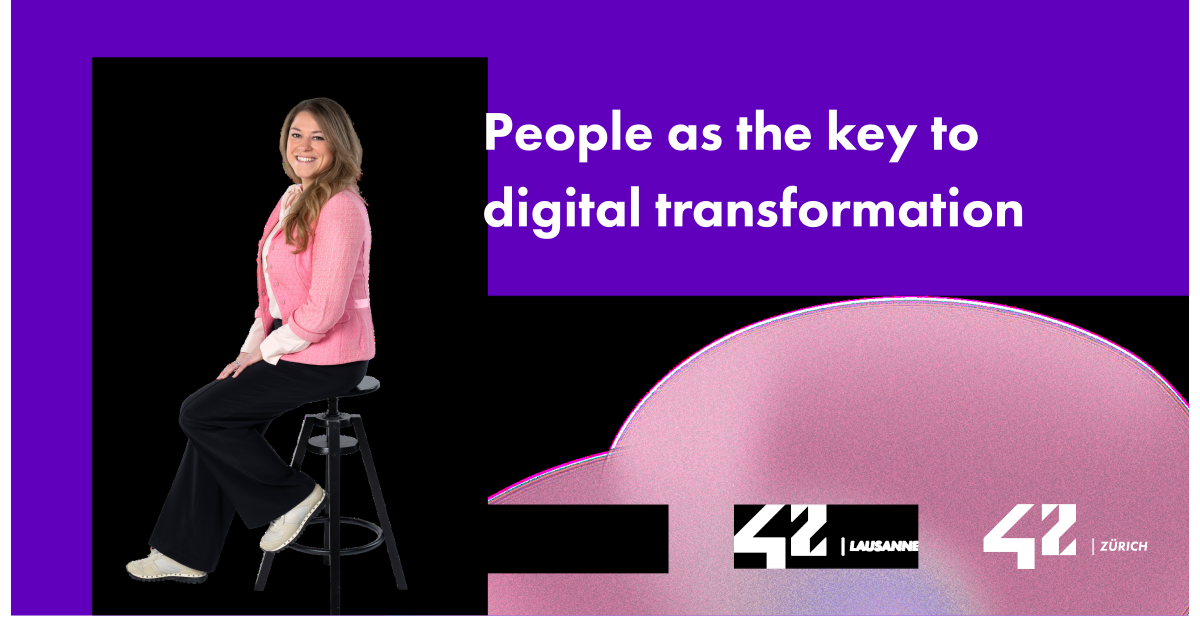
Behind every successful digital transformation lies a human element that is often overlooked. Viktoria Mauz, an account manager at Nokia, demonstrates through her career that technical success is only sustainable if it involves the people within the company.
In our conversation, Viktoria explains how her background in economics led to a passion for technology and why she is convinced that: “Technology is just a tool. People are at the heart of it.”
From a degree in business administration to a career in technical leadership
After completing a technical A-levels, she opted for a dual degree programme in Business Administration at the Baden-Württemberg Cooperative State University. “I really wanted to have that link to the business world and to know that I could apply what I was learning at university in a practical setting,” she explains.
Her first role took her into the automotive industry, where she worked in metalworking and later collaborated with Audi on the development of powertrains for today’s electric vehicles. This was followed by a spell at Liebherr, where she worked on diesel and hydrogen engines.
But in production, she came up against a fundamental problem: digitalisation had stalled. Despite the tools being available, processes remained manual and inefficient. “Why are so many digitalisation initiatives failing to make progress?” she wondered.
This question led her to pursue a PhD whilst working full-time. Her four-year research project focused on digital transformation. She later worked at a consultancy firm, where she developed bespoke applications for the industrial sector, and eventually made the move into the software industry. Her goal: to bridge the two worlds of hardware and software. At Nokia, she now has the opportunity to do just that by building infrastructure to drive digitalisation forward.
The triangle of change: technology, people, culture
Viktoria has a clear strategy for every change. She defines a “triangle of influencing factors”: technology (e.g. AI, the cloud, networks), people and corporate culture. “If I want to actively bring about change, I don’t start with the tool, but with the people and the culture,” she explains.
A clear example of this is their work with autonomous vehicles in production. The technological foundation was already in place: a cellular network that ensures a consistently stable and secure connection for the autonomous delivery vehicles. However, staff feared job losses due to automation and had doubts about the reliability of the vehicles.
The solution lay not in a better algorithm, but in the three-pronged approach. Instead of simply installing the technology, they opted for a proof of concept (POC) carried out directly on site. They demonstrated to staff in real time how the system works: “We show staff on site: ‘Look, this works; it takes the pressure off you and supports you.’” It was only through this direct experience and dialogue that they managed to allay fears and get the staff on board. “It’s not about doing everything from scratch, but about supporting people,” says Viktoria.
Only when the right culture is in place and people feel confident can technology realise its full potential.
Human-Centred Digital Transformation: Security and Empowerment
A key theme in Viktoria’s work is human-centred digital transformation. On 5 May 2026, she gave a talk on ‘The Powerhouse of Human-Centred Digital Transformation’ at Swiss ICT. “It’s not about rolling out a new tool, but about supporting employees,” she emphasises.
A company is an ecosystem. To be successful, employees must be empowered. This includes fostering a culture that embraces mistakes. “Everyone makes mistakes. How does the company deal with this? If employees overthink everything and are afraid to take the lead, there is a lack of a culture that allows for quick experimentation,” says Viktoria Mauz.
A company is an ecosystem. To be successful, employees must be empowered.
She also addresses the anxiety many people feel about new tools. “What does it mean for me when a new tool is introduced? Is it only being introduced to save money?” she asks. Her answer: ongoing training builds confidence. “Everyone wants to work in a winning team. When we reach a milestone, we have to celebrate it, even if it only took three months.”
A clear focus, a clear purpose: infrastructure for a connected world
The focus is not on the individual customer, but on Nokia’s global role as a provider of critical network infrastructure. Nokia is a leading provider of connectivity in the age of AI and delivers the technological foundations on which modern societies depend. These networks form the backbone for data-intensive applications and AI-based systems, where stability, speed and security are non-negotiable.
Building a community and removing barriers
As well as her work at Nokia, Viktoria Mauz is actively involved in the Swiss ICT Innovation Group. She believes it is important to build a community where professionals can discuss real-world issues, rather than just business matters.
“There are far too few women in technology,” she says. “I really enjoy sharing my story because my financial background and my passion for technology enable me to make a real difference in the tech sector.”
“Set yourselves goals; don’t compare yourselves with others, but with yourselves.“
Her advice to young women is both pragmatic and personal: “Set yourselves goals; don’t compare yourselves with others, but with yourselves. I ran my first 10-kilometre race not to beat others, but to achieve my own goal.” For her, it is important that women understand that they don’t have to be perfect to be part of the tech world – but that it’s about finding their own path and actively helping to shape it.
Technology with a purpose
Viktoria’s story shows that technology does not exist in a vacuum. It takes people who understand why something isn’t working and who are prepared to change the culture and processes. “I want what I do to have a purpose. And that purpose lies in moving society forward, not just writing code.”
Viktoria Mauz
Viktoria is an experienced executive in the field of digital transformation who is committed to promoting greater diversity in the tech industry. As an account manager at Nokia, she connects people, organisations and technology, as she firmly believes that true digital transformation is a matter of communication, not just software.
Alongside her professional work, Viktoria is involved in the innovation sector as a member of Swiss ICT. Her aim is to create a culture in which technological innovations offer genuine social value and in which everyone can find their place.

The interview was conducted by Corina Schedler as part of the initiative to promote gender equality in computer science education, which is supported by the Federal Office for Gender Equality (EBG).